kein Widerspruch
Without the influence of human activity, Central Europe would almost exclusively be covered by forests. This woodland would not be very abundant in species, because many herbaceous plants could not exist under the leafy canopy of the trees due to a lack of light.
In Mitteleuropa hätten wir ohne Einwirkung des Menschen einen nahezu geschlossenen Waldbestand. Dieser wäre nicht besonders artenreich, weil viele krautige Pflanzen unter dem Blätterdach der Bäume aus Lichtmangel kein Auskommen hätten.
These conditions would also prevail at
gypsum locations with relatively shallow soils, and in fact they can still
be encountered in various places. However, as small-scale farming structures
with the cultivation of crops and pasture farming emerged, numerous plant
species were able to immigrate into these open habitats from almost all
directions and different climatic zones.
Dieser Zustand wäre auch auf Gipsstandorten mit relativ flachgründigen Böden anzutreffen bzw. es gibt ihn in verschiedenen Orten auch heute. Mit dem Entstehen kleinbäuerlicher Strukturen und dem Anbau von Nutzpflanzen sowie der Weidewirtschaft konnten zahlreiche Pflanzenarten in die offenen Lebensräume aus nahezu allen Himmelsrichtungen und aus verschiedenen Klimazonen einwandern.
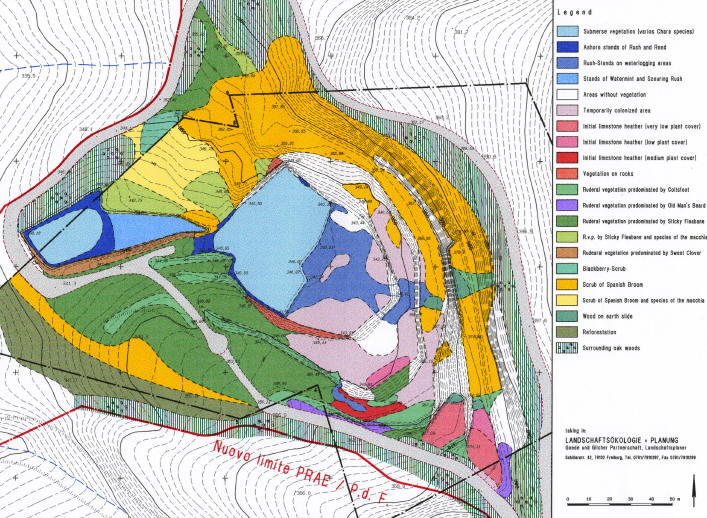
Fig. 1: Large variety of biotops and
plant communities in a gypsum quarry in Tuscany 10 years after closing down
operations.
Abb. 1: Biotopvielfalt und
Pflanzengesellschaften in einem Gipssteinbruch in der Toskana 10 Jahre nach
Beendigung der Abbauaktivitäten.
Further figures of the Tuscany gypsum quarry
Weitere Ansichten des Gipssteinbruches in der Toskana
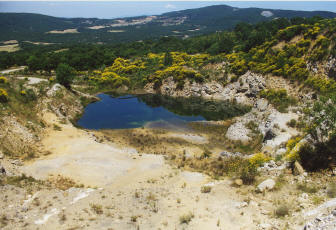
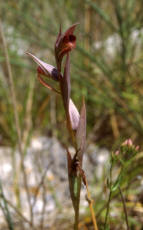
Fig. 1a / Abb. 1a
Fig. 1b / Abb. 1b Serapis lingua
Fig. 1c / Abb. 1c Chara spec.
The number of species steadily increased. In this context, we have to keep in mind that initially no mineral fertilizers and agrochemicals, such as pesticides, were available. It was not until the development of these products, together with the advancing mechanization of agriculture and the expansion of farm sizes, which is still in progress, that a partially dramatic decrease in species numbers was to be observed. Almost 30 % of our plant species (and, of course, animal species as well) are "endangered", "highly endangered" or already "extinct". The Red Data Books, which record this development, are becoming more and more extensive.
Die Zahl der Arten stieg zunehmend an. Dabei muss man sich vergegenwärtigen, dass zunächst keine mineralischen Düngemittel und Agrochemikalien, wie z. B. Pflanzenschutzmittel, zur Verfügung standen. Erst mit der Entwicklung dieser Mittel, verbunden mit einer ständigen Mechanisierung in der Landwirtschaft und einer bis heute andauernden Vergrößerung der Betriebe geht eine Abnahme der Arten einher, die teilweise dramatisch ist. Fast 30 % unserer Pflanzenarten (und natürlich auch Tierarten) sind in ihrem Bestand gefährdet, stark gefährdet oder bereits ausgestorben. Die "Roten Listen", die diese Entwicklung dokumentieren, werden immer umfangreicher.
This negative development is aggravated by large-scale eutrophication from the air (for example in the form of nitrogen immissions from industry, private heatings and traffic). As a result of the large supply of nutrients, tall-growing species displace low-growing plants, and omnipresent species, also known as ubiquists, displace rare plants.
Die negative
Entwicklung wird durch die flächenhafte Eutrophierung aus der Luft versträkt
(z. B. Stickstoffeinträge aus Industrie, Hausbrand und Verkehr). Durch das
große Nährstoffangebot verdrängen höherwüchsige Arten kleinwüchsige und
sogenannte "Allerweltsarten" (Ubiquisten) verdrängen seltene Pflanzen.